Some of y’all might remember the Great Shitposting Event of December 2017, spearheaded by @cerulean-shark and @verymaedhros, aided and abetted by @tyelperinquar, @fuindar-valen, @saltysquidtea, @cataclysmofstars, @vampiraptor, and probably some other people who I’m forgetting (sorry!). As for me, I have never shitposted in my life. (She blatantly lied.)
And if not, this thread, originally posted by Vmae, tells you all you need to know. The thread deals with his passage from the Lay of Leithian:
‘Thou fool: a phantom thou didst see that I, I Sauron, made to snare thy lovesick wits. Naught else was there. Cold ‘tis with Sauron’s wraiths to wed! Thy Eilinel! She is long since dead… ’
and the discussion was of whether or not this meant that Gorlim and also Sauron had canonically slept with a wraith.
There’s a widespread understanding within the Tolkien fandom that Tolkien never wrote about sex. Ever. Even in the stuff he wrote privately for himself and didn’t intend to publish. And so wherever something turns up in canon that hinted at possibly some non-platonic entanglements, a giggle goes around at daft Grampa T who was so prudish he didn’t recognize the sexual subtext within his own work, the shippers write their fic, and everyone goes about their lives. (Of course, this interpretation ignores that Tolkien canonically wrote an incestuous relationship in The Children of Hurin.)
Which is what I did too until recently. A little over a month ago, I got into one of Tolkien’s lesser known, non-Middle Earth works. The Lay of Aotru and Itroun, (good luck with the pronunciation, I don’t know either) is set in the Real World, “In Britain’s land beyond the seas,” aka Brittany, and the plot follows a nobleman and his wife who are trying to conceive. Of course she doesn’t, so Aotru seeks out a witch, who promises to give him a potion for his wife in return for an unknown price to be paid sometime later. Itroun get pregnant, and in the spring Aotru is hunting in the woods, and who does he meet but that witch again! Except now she’s young and hot, and it’s questionable whether she’s wearing any clothing, and this is what she says to Aotru:
For this at least I claim my fee,
if ever thou wouldst wander free.
With love thou shalt me here requite,
for here is long and sweet the night;
in druery dear thou here shalt deal
in bliss more deep than mortals feel.’
Italicized as in the original. In case it isn’t clear that the witch/fairy is requesting Aotru repay her by having sex with her, the footnotes helpfully inform us that “druery” means “love-making.” Count on Tolkien to use an archaic term that has gone out of use instead of the prosaic “fucking.”
Let Tolkien say “fuck” 2k18.
This leads me to believe that I’ve been approaching parts of Tolkien’s work all wrong. Instead of turning cognitive cartwheels to figure out what Tolkien meant if he wasn’t talking about sex, it seems that I should roll with the more intuitive interpretation, and assume that in at least some of the cases that he was actually talking about sex. Which doesn’t mean that at other times he couldn’t have been speaking metaphorically in other cases. (Such as Melkor’s lust for the Silmarils. Or, maybe Melkor was just really into geology.)
Upshot: Gorlim/Wraith is probably a canon ship. Also, some of us (such as me) have been missing out on this whole other side of Tolkien’s work, because we’ve been dismissing the sexual subtext as the creations of people scrabbling to support their ship.
And I don’t believe in Tolkien’s personal life having any bearing on how I interpret his works, but it does stretch my credibility to suggest that a veteran for crying out loud, and someone who studied mythology, would be writing merrily along like “Sexual innuendo? I have never heard of it.”
Grrrr it works when I uploaded it but not when I click save, I might have to post separate images T T * I made the file a lot smaller, hope this works T T*
Yay it works but now its super blur so yeah separate images will be up soon > <
Yay my first gif! So this is an age lapse of Maedhros, from childhood to well death.
First frame is Maedhros as a child, a precocious elfling who was spoilt by his grandparents, parents and relatives, at least till the arrival of maglor and his younger cousins.
Second frame is him as a teen- practically a youth enjoying Aman before the death of the two Trees, before the Silmarils.
Third frame is post Oath, after the death of Finwe and the death of the two Trees.
Fourth frame is post First Kinslaying and arrival in Beleriand. I used the same drawing but tweak a few things because there isn’t much growth in Maedhros at this stage.
Last frame is post Thangarodrim till death.
My hand and wrist are screaming for a divorce at this point T T I’ll add the stills later on if anyone is interested? And also I was planning to do an age lapse for all the brothers was after this monster I might just limit it to a few choice elves T n T
Also headcannon for scars: elves are supposed to possess super healing abilities and stuff, but if Morgoth can torture elves till they turn into orcs, surely he can inflict permanent wounds on an elf because its a cursed wound of a sorts, a wound that affects the fea as well. So wounds to the fea = sort of permanent.
Ok guys, sorry for the double post but a few people pointed out that some of the sketches in my SilmDumps are really small, so here they are in all their glory (?).
So, angsty/sleeping Maedhros (take your pic), baby Maedhros, short hair Maedhros, Celegorm and Huan, Curvo’s hands, angsty Maedhros take 2, modern lost Maglor, baby Ambarussa, sleeping Moryo and Maedhros’ hand because I’m a happy snail and I like Maedhros (after 5 Mae doodles I’m sure you might have guessed it)
And now I’m off to draw some sad stuff, probably. Stupid hormones.
Most composers spend just 10-12ish weeks working on a film’s music. John Williams spent around 14 weeks on each Star Wars movie, 40ish weeks total for the whole OT……but composing the LOTR trilogy’s soundtrack took four years
The vocals you hear in the soundtrack are usually in one of Tolkien’s languages (esp. Elvish). The English translations of the lyrics are all poems, or quotes from the book, or occasionally even quotes from other parts of the films that are relevant to the scene
When there were no finished scenes for him to score, Howard Shore would develop musical themes inspired by the scripts or passages from the book. That’s how he got all Middle-Earth locations have their own unique sound: he was able to compose drafts of “what Gondor would sound like” and “what Lorien would sound like” long before any scenes in those places were filmed
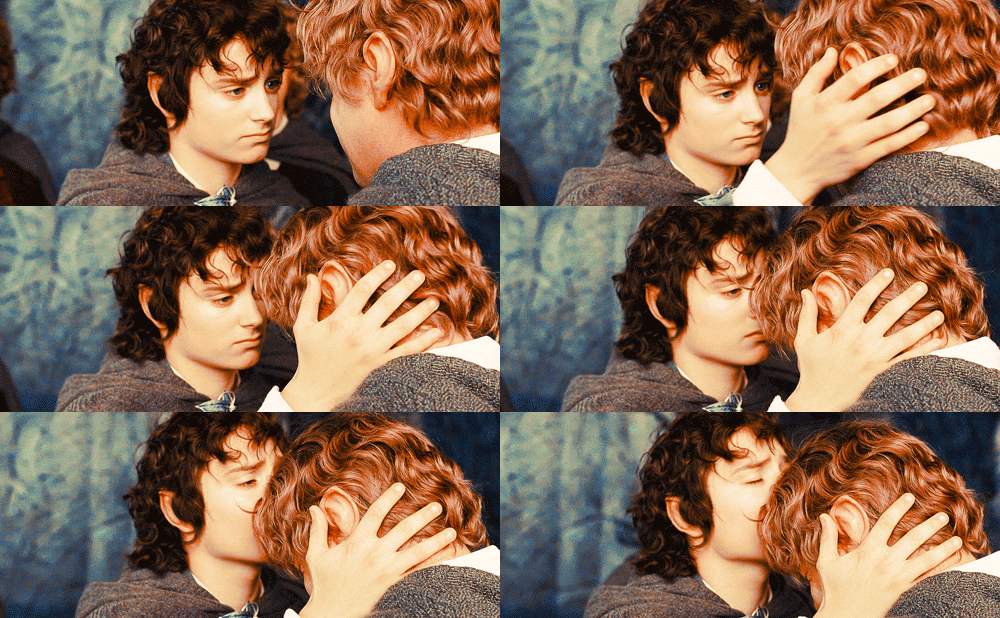
Shore has said his favorite parts to score were always the little heartfelt moments between Frodo and Sam
Shore wrote over 100 unique leitmotifs/musical themes to represent specific people, places, and things in Middle Earth (over 160 if you count The Hobbit)
The ones we all talk about are the Fellowship theme, the main Shire Theme, and the themes for places like Gondor, Mordor, Rohan, and Rivendell…but a lot of the more subtle ones get overlooked and underappreciated
Like Aragorn’s theme. It’s a lot less “obvious” than the others because, like Aragorn himself, it adapts to take on the color of whatever place Aragorn is in: it’s played on dramatic broody stringed instruments in Bree, on horns in battle scenes, softly on the flute with Arwen in Rivendell….
Eowyn has not just one but three different leitmotifs to represent her
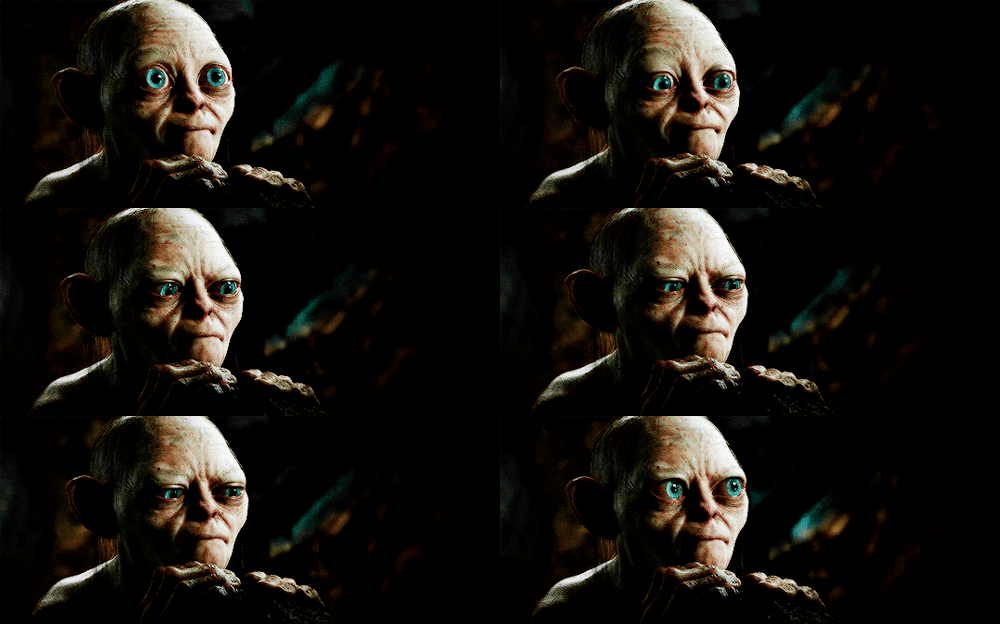
Gollum and Smeagol both have their own leitmotifs! Whose theme music is playing in the scene can often tell you whether the Gollum or Smeagol side is “winning” at the moment
The melody for Gollum’s Song in the end credits of the The Two Towers is the Smeagol and Gollum themes smushed together (it’s Symbolic)
And then there’s the really obscure ones. Like there’s a melody that plays at Boromir’s death that shows up again in ROTK in scenes that foreshadow a major death or loss
Shore wanted the theme music to grow alongside the characters– so that as the characters changed, their theme music would change with them.
You can hear that most clearly in the Shire theme. Like the hobbits, it goes through A Lot
Like compare the childish lil penny whistle theme you hear in Concerning Hobbits/the beginning of FOTR with (throws a dart at random Beautiful Tragic Hobbit Character Development scene because there WAY TOO MANY to choose from) the scene when Pippin finds Merry on the battlefield, where you hear a kind of shattered and broken but more mature version of that same theme in the background
I could write you a book on how much I love the way the Shire theme grows across the course of these films
Unlike the hero’s themes, which constantly change and grow, the villain’s themes (The One Ring theme, the Isengard theme, etc) remain basically the same from the very beginning of FOTR to the end of ROTK. Shore said this was an intentional choice: to emphasize that evil is static, while good is capable of change
Shore has said that between all the music that made into the movies and the music that didn’t, he composed enough for “a month of continuous listening”……..where can I sign up
3) “True” form, End of the First Age – Second Age,until the downfall of Numenor. After battle on Tol-in-Gaurhoth Sauron was not in favor, and after War of Wrath he lost his master Melkor. He refused to return to Valinor with Eonwe and stayed in Middle Earth. For 600 years he begin to slowly lose his mind. His hair became gray and his beauty fades away.
4) End of the Second Age. Sauron dies during downfall of Numenor. His spirit can’t take a “fair” form anymore – since this moment his physical form became horrible

 Aowyn Tumblr Backup