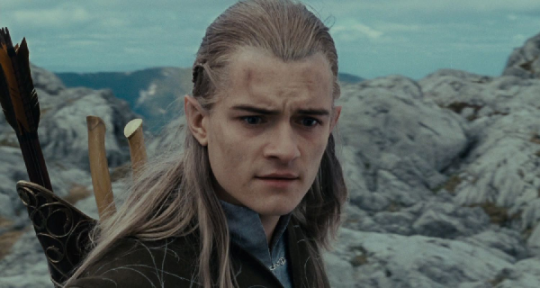
Legolas pretty quickly gets in the habit of venting about his travelling companions in Elvish, so long as Gandalf & Aragorn aren’t in earshot they’ll never know right?
Then about a week into their journey like
Legolas: *in Elvish, for approximately the 20th time* ugh fucking hobbits, so annoying
Frodo: *also in Elvish, deadpan* yeah we’re the worst
Legolas:
~*~earlier~*~
Legolas: ugh fucking hobbits
Merry: Frodo what’d he say
Frodo: I’m not sure he speaks a weird dialect but I think he’s insulting us. I should tell him I can understand Elvish
i mean, honestly it’s amazing the Elves had as many languages and dialects as they did, considering Galadriel (for example) is over seven thousand years old.
english would probably have changed less since Chaucer’s time, if a lot of our cultural leaders from the thirteenth century were still alive and running things.
they’ve had like. seven generations since the sun happened, max.
frodo’s books are old to him, but outside any very old poetry copied down exactly, the dialect represented in them isn’t likely to be older than the Second Age, wherein Aragorn’s foster-father Elrond started out as a very young adult and grew into himself, and Legolas’ father was born.
so like, three to six thousand years old, maybe, which is probably a drop in the bucket of Elvish history judging by all the ethnic differentiation that had time to develop before Ungoliant came along, even if we can’t really tell because there weren’t years to count, before the Trees were destroyed.
plus a lot of Bilbo’s materials were probably directly from Elrond, whose library dates largely from the Third Age, probably, because he didn’t establish Imladris until after the Last Alliance. and Elrond isn’t the type to intentionally help Bilbo learn the wrong dialect and sound sillier than can be helped, even if everyone was humoring him more than a little.
so Frodo might sound hilariously formal for conversational use (though considering how most Elves use Westron he’s probably safe there) and kind of old-fashioned, but he’s not in any danger of being incomprehensible, because elves live on such a ridiculous timescale.
to over-analyse this awesome and hilarious post even more, legolas’ grandfather
was from linguistically stubborn Doriath and their family is actually from a
somewhat different, higher-status ethnic background than their subjects.
so depending on how much of a role Thranduil took in his
upbringing (and Oropher in his), Legolas may have some weird stilted old-fashioned speaking tics in his
Sindarin that reflect a more purely Doriathrin dialect rather than the Doriathrin-influenced Western Sindarin that became the most widely spoken Sindarin long before he was born, or he might have a School Voice
from having been taught how to Speak Proper and then lapse into really
obscure colloquial Avari dialect when he’s being casual. or both!
considering legolas’ moderately complicated political position, i expect he can code-switch.
…it’s
also fairly likely considering the linguistic politics involved that Legolas is reasonably articulate in Sindarin, though
with some level of accent, but knows approximately zero Quenya outside of loanwords into Sindarin, and even those he mostly didn’t learn as a kid.
which would be extra hilarious when he and gimli fetch up in Valinor in his little homemade skiff, if the first elves he meets have never been to Middle Earth and they’re just standing there on the beach reduced to miming about what is the short beard person, and who are you, and why.
this is elvish dialects and tolkien, okay. there’s a lot of canon material! he actually initially developed the history of middle-earth specifically to ground the linguistic development of the various Elvish languages!
Legolas: Alas, verily would I have dispatched thine enemy posthaste, but y’all’d’ve pitched a feckin’ fit.
Aragorn: *eyelid twitching*
Frodo: *frantically scribbling* Hang on which language are you even speaking right now
Pippin, confused: Is he not speaking Elvish?
Frodo, sarcastically: I dunno, are you speaking Hobbit?
Boromir, who has been lowkey pissed-off at the Hobbits’ weird dialect this whole time: That’s what it sounds like to me.
Merry, who actually knows some shit about Hobbit background: We are actually speaking multiple variants of the Shire dialect of Westron, you ignorant fuck.
Sam, a mere working-class country boy: Honestly y’all could be talkin Dwarvish half the time for all I know.
Pippin, entering Gondor and speaking to the castle steward: hey yo my man
As always the answer in this fandom is “Telperinquar, unless you look deeper, in which case maybe it’s Tyelperinquar, unless you look deeper, in which case it’s entirely about what you think would have been the fictional political affiliations of long-dead underspecified Elves.”
Does ‘Tyelperinquar’ exist
in that form in Tolkien’s writing? This
is the given Quenya translation for Celebrimbor in Helge Fauskanger’s
Quenya-English wordlist (which I generally trust above all others), but I’ve
always wondered if this is either a typo or an editorial correction – the
references cited in the wordlist do not have this form.
In addition to the sources
you’ve cited, we have the following in Parma
Eldalamberon XVII, p 42, Celebrimbor: ‘The Quenya equivalent was Telpinquar, or Telperinquar.’
In a strictly Quenya sense,
Telperinquar would be Tyelperinquar. (This
suits my headcanon, and I like the sound of the word better. If in doubt when speaking Elvish, always go
with the best sound. The Elves would.)
Telperinquar is what I’ve always seen, too (I was pretty bewildered at first to say Tyelperinquar/Tyelpe so widely used). Tolkien does say in UT that Telerin telpe was adopted into Quenya and more common than tyelpe, since the Noldor admired their skill as silversmiths. Fauskanger refers to it in his discussion of Telerin. So it’s Telperion and not Tyelperion, and likewise in the frozen Quenya of the Númenóreans: Telperiën, Telemmaitë, Telemnar.
I started Hebrew, which is why I’ve been dead on this blog, but I don’t think I can ever properly convey to you guys the sheer cultural whiplash of spending years learning Japanese from Japanese teachers and then trying to learn Hebrew from an Israeli
Japanese: you walk into class already apologizing for being alive Hebrew: you walk into class, the teacher insults you and you are expected to insult her back
Japanese: conjugates every single verb based on degree of intended politeness, nevermind keigo and honorifics Hebrew: Someone asked my teacher how to say “excuse me” and she laughed for several seconds before saying we shouldn’t worry about remembering that since we’ll never need to say it
Japanese: if you get one stroke wrong the entire kanji is incomprehensible Hebrew: cursive? script? fuck it do whatever you want, you don’t even have to write the vowels out unless you feel like it
Japanese: the closest thing there is to ‘bastard’ is an excessively direct ‘you’ pronoun Hebrew: ‘bitch’ translates directly
Fun fact: Israel has possibly the lowest power-distance metric of any culture in the world, while Japan has one of the highest. I didn’t realize that the CTO of my company was the CTO until somebody else told me, because everybody called him by his first name and engaged in mutual shit-talking/playful insults with him.
In Japan, even calling your boss by the wrong honorific is liable to get you in trouble.
And apparently there’s some sciencey cooperative venture going on between Israel and Japan in an official diplomatic capacity. I want to be a fly on the wall when Japanese and Israeli scientists work together.
I mean, the language was developed to argue with g-d, so.
One of my favorite things about Adûnaic (as I think I’ve mentioned) is that it has two words for night. Lômi, a “fair night under the stars,” the night of Varda – and dolgu (earlier nûlu), from the same root as dulgî (black), night with evil associations.
What I didn’t realize until just now is that lômi is an obvious borrowing from Quenya lómë, meaning night or evening. This is really unusual! There are several other Adûnaic words with Eldarin roots, but those were all introduced into Taliska due to early contact with the Avari way back when. this can’t be the case with lóme: in the etymologies, it’s given as a reflex of Primitive Quendian dô or do3mê (which also appears in Sindarin dû, meaning twilight). No other Eldarin language has that form, it has to be from Quenya.
Interestingly enough, Quenya alsoseems to have this distinction, although it’s much less marked. Their other word for night, fui or hui, appears in compounds having to do with murk, gloom, or darkness; it’s the same root as the Sindarin (see Taur-nu-Fuin). The semantic scope of lómë tends towards twilight or dusk, although it also includes full night. It’s used in compounds like lómelindë (nightingale). Hui, of course, isn’t related to dolgu, which is if anything another reflex of dô.
So what’s going on? Helge Fauskanger (the Ardalambion guy) thinks the positive connotations of Adûnaic lômi are simply a vestige of its association with the Eldar and, thus, Valinor, but I don’t buy it. Other Adunaic words or Eldarin origin don’t appear to have strong positive connotations. More significantly, lómë seems to have those positive connotations already in Quenya.
So it’s definitely most likely that this borrowing took place during or immediately after the War of Wrath, which is the first time the pre-Númenoreans would have been living in any proximity to large groups of Quenya-speaking people. But I have another theory. Quenya’s banned for almost the entire first age. There’s just one notable moment when the Noldor violate that prohibition – a moment when, as it happens, a massive group of Men are also present:
But now a cry went up, passing up the wind from the south from vale to vale, and Elves and Men lifted their voices in wonder and joy. For unsummoned and unlooked for Turgon had opened the leaguer of Gondolin, and was come with an army ten thousand strong, with bright mail and long swords and spears like a forest. Then when Fingon heard afar the great trumpet of Turgon his brother, the shadow passed and his heart was uplifted, and he shouted aloud: ’Utulie’n aure! Aiya Eldalie ar Atanatari, utulie’n aure! The day has come! Behold, people of the Eldar and Fathers of Men, the day has come!’ And all those who heard his great voice echo in the hilss answered crying: ’Auta i lómë! The night is passing!’
Of course, we all know what happens next. Still, I like to think this is what persists in Edainic historical memory. The moment of light in the darkness – it’s perfectly appropriate that the lasting image it produces is twilight, transitional, a star-filled night.
being bilingual is understanding but not being able to translate because your brain couldn’t be bothered to do any extra work and is just content with knowing what the heck is going on
Being bilingual is sitting in the class of your second language and people asking you to translate the word and you struggle because you get the meaning, the feeling, the general aim of the word but can’t even use your own language to translate it.
Being bilingual is trying to express something but you can only express it in the your second language so you just say nothing
 Aowyn Tumblr Backup