it’s common knowledge that the names of the three elven rings match the fates of the three Silmarils, but think about the ring-bearers, too —
elrond is obvious; he had the ring of air, but he didn’t have his father, who was sailing through the sky with a silmaril on his brow
galadriel and maglor were the last of the grandchildren of finwë left in middle-earth; she bore the ring of water and longed to go back across the sea all that time, while his fate was to wander the shoreline after he flung his silmaril into the sea
gandalf, wearing the ring of fire, fell into the deepest parts of moria battling a demon made of flame; maedhros threw himself and his silmaril into a fiery chasm
and i wonder if the wise and knowledgeable ring-bearers could’ve noticed this, and if gandalf’s death would’ve, in a way, completed the last of the parallels
and i wonder, then, if a part of him knew, or perhaps thought he knew, that at some point he would have to die.
“Then suddenly… [Sam] remembered the gift of Galadriel. He brought the box out and showed it to the other Travellers… and asked their advice. Inside, it was filled with a grey dust, soft and fine, in the middle of which was a seed, like a small nut with a silver shale…
So Sam planted saplings in all the places where specially beautiful or beloved trees had been destroyed, and he put a grain of the precious dust in the soil at the root of each… And at the end he found that he still had a little of the dust left; so he went to the Three-farthing Stone, which is as near the centre of the Shire as no matter, and cast it in the air with his blessing…
Spring surpassed his wildest hopes. His trees began to sprout and grow, as if time was in a hurry and wished to make one year do for twenty…
Altogether 1420 in the Shire was a marvellous year. Not only was there wonderful sunshine and delicious rain, in due times and perfect measure, but there seemed something more: an air of richness and growth, and a gleam of a beauty beyond that of mortal summers that flicker and pass upon this Middle-earth. All the children born or begotten in that year, and there were many, were fair to see and strong, and most of them had a rich golden hair that had before been rare among hobbits.” Return of the King p367-368
What I’m getting from this is that Galadriel didn’t only give three of her hairs to Gimli, she also gave her hair to half the baby hobbits of the Shire…
Imagine when Celeborn does arrive, telling his wife ALL about the goldenhaired Hobbits… and one of her brothers jokingly asks if she will claim them as her children.
Just.
Imagine.
The.
Look.
On.
Celeborn’s.
FACE.
Meanwhile Finarfin would be all over the cuteness of it, forcing anyone who’s ever seen a Hobbit to draw him pictures of his “Grandkids”.
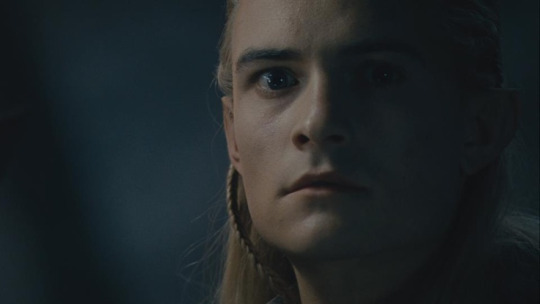
This is right after Gandalf says, “A balrog. A demon of the ancient world.”
I just love how PJ chose to cut to Legolas’ face because he is exactly who you should cut to at this moment. You need an elf to show what it really means. Other than Gandalf, the rest of the Fellowship can sense something is gravely wrong, but they don’t understand just how grave. Like Gandalf, Legolas knows the terror. He understands the gravity of what lies around that corner. He’s got a piddly little bow and he is mere steps away from a demon of the ancient world. This frame shows a kid coming to the realisation that he is way out of his depth, that this mission will take him to places he only knew to exist in legends of the Elder Days, a time long gone, barely history.
He’s probably one of the youngest elves in Middle Earth at this point. He probably grew up on stories of the balrogs, slaying the ancient High Kings of the Eldar and tearing Middle Earth apart, thousands and thousands of years ago. They are legends in old crumbling books, read illicitly by a little elfling who was kept up at night by the terrible tales.They are the monsters under the bed and the shadows in the heart of the forest. They are the beasts behind the winged hordes of hell, that older elves, who’ve seen the worst that Arda has to offer, always assured him were no more than distant nightmares, stories relegated to dust and ancient memory. Except now they are real. They are here. They are coming.
I love the idea of these stout, hairy, dirt-under-their-nails people writing the most beautiful poetry; singing the loveliest songs; being the floweriest mofos to ever pop out of the ground.
And I can’t stand when people say it’s not proper to have them like that simply for being dwarves. That’s wrong. So wrong. Because there’s so much diversity, in this world and fantasy ones.
Why should all dwarves be lumped together as vulgar, ineloquent beasts?
Why should all elves be pristine, clean, and graceful?
Why should all hobbits be scared, weak, and uneducated about the outside world?
Great stories are made from bending the ideas that have been laid out before, not sticking to them like bugs to flypaper.
“And, Legolas, when the torches are kindled and men walk on the sandy floors under the echoing domes, ah! then Legolas, gems and crystals and veins of precious ore glint in the polished walls; and the light flows through folded marbles, shell-like, translucent as the living hands of Queen Galadriel. There are columns of white and saffron and dawn-rose, Legolas, fluted and twisted into dreamlike forms; they spring up from many-coloured floors to meet the glistening pendants of the roof: wings, ropes, curtains fine as frozen clouds; spears, banners, pinnacles of suspended palaces! Still lakes mirror them: a glimmering world looks up from the dark pools covered with clear glass; cities, such as the mind of Durin could scarce have imagined in his sleep, stretch on through avenues and pillared courts, on into the dark recesses where no light can come. And plink! a silver drop falls, and the round wrinkles in the glass make all the towers bend and waver like weeds and corals in a grotto of the sea.”
Gimli, The Two Towers
(the “Glittering Caves” speech is often cited as Tolkien’s most beautiful and lyrical writing ever. Hell yeah, I am down with poetic Dwarves!)
The Glittering Caves speech is gorgeous. And Gimli is clearly shown to be an eloquent character throughout the book:
-His very first lines in FotR have him engaging in a bit of wordplay with Elrond:
‘Faithless is he that says farewell when the road darkens,’ said Gimli.
‘Maybe,’ said Elrond, ‘but let him not vow to walk in the dark, who has not seen the nightfall.’
‘Yet sworn word may strengthen quaking heart,’ said Gimli.
‘Or break it,’ said Elrond
And we can’t forget that Gimli asks Galadriel for a gift of her hair – something denied even to Feanor – and she specifically comments on his eloquence: “None have ever made to me a request so bold and yet so courteous.” In doing so, she practically scolds the gathered elves for their prejudice against the dwarves and their belief that they have no skill in words. And with good reason! Gimli’s request is lovely and poetic, saying that her beautiful hair “surpasses the gold of the earth as the stars surpass the gems of the mine.”
There’s also that haunting moment in Khazad-dum where Gimli recites some dwarven poetry to the Fellowship. The poem (read it here – it’s quite long so I won’t paste it) is so haunting, filled with loss and grief and longing. Gimli’s recital clearly has an effect on the Fellowship, and Sam (who, as we know, loves poetry and even writes it himself) liked it so much that he wanted to learn it.
Gimli is only one dwarf, of course, and he’s clearly a dwarf of some status and education, but he’s Tolkien’s greatest representation of the dwarves and clear evidence that they can be eloquent and poetic.
WARNING! I’M ABOUT TO GO INTO SOME SLIGHT GORE/VIOLENCE/WEAPON PHYSICS META OF SORTS
Spock was shot in the back. We see that from the way he falls. There is blood on the front of his uniform, which means that the bullet went clean through his chest and made an exit wound.
There is quite a bit of debate about what type of bullet wound is worse, a clean one or an embedded one, but the general consensus is that both are very bad, and it is better not to get shot at all!
If you have an exit wound like Spock does, even though his heart isn’t in his chest, he’s going to lose a lot of blood from that wound.
If Jim was checking for a heart rate, he would likely be using it to gauge how bad Spock’s condition is. If his heart-rate was elevated, it would mean he was going into shock from blood loss, and that would definately be a cause for panic.
Nelyafinwë and its derivatives would only have alienated Fingolfin’s supporters further – third Finwë,
Fëanáro named him, as though his half-brothers did not count. Russandol he has not heard since childhood; hearing Findekáno use it now is to pour salt into an open wound. And since Thangorodrim Maitimo has felt like a cruel joke.
So he takes Maitimo and Russandol, the two of his names that are not insults, and puts them together. Maedhros fits him well; it is the language of this new land, a name that has never been turned against him. He wears it with pride.
ii.
Those who love him call him Macalaurë.
Maglor is hideous, Canafin even more so. His name is Macalaurë
Canafinwë son of Fëanáro, and Elu Thingol – see, he is willing to use Sindarin names for those who want them – cannot change it. Names are important and Macalaurë will not give his up.
Others call him Maglor, call his land Maglor’s Gap, and
Macalaurë becomes accustomed to it but never fails to notice.
iii.
He is Tyelcormo, Celegorm, what does it matter? As long as he is not called Turkafinwë, he does not care.
iv.
His brothers call him Moryo, and his allies call him Caranthir, and his enemies call him dark one, red faced, and he calls himself Carnistir still – a habit of millennia does not break easily – but he does not, truly, care.
v.
He calls himself Curufin, Curufinwë. For
Fëanáro to give him his own fathername is a rare gift, a show of inheritance that not even Nelyo was given, and Curufin values that gift more than he values the language it was given in.
He is skilled, and like his father – not merely his father’s echo, as Atarincë
would imply, but his father’s favored son. They say he is Fëanor come again, and Curufin smiles.
vi.
They were always Ambarussa, before – his brother’s mothername was Ambarto, but together they were Ambarussa. his name is Ambarussa now. He could change his own name, but he will not change his brother’s.
People who act like Middle Earth would be such a great place to live are apparently not aware that that entire world circa Lord of the Rings and The Hobbit is in fact post-apocalyptic
Observe, this supposedly idyllic fantasy world consists of:
– crumbling eleven settlements
– shrinking kingdoms of Men
– governments and kings either absent or hilariously under equipped to face the evils of the world
– all but a handful of the ancient dwarven settlements are in the hands of orcs OR WORSE
– Thorin and Co. could barely take one step off the road before being nearly EATEN BY TROLLS (OR WORSE) because there’s absolutely NO safety or rule of law whatsoever
– Gandalf basically hangs out in the Shire because it’s the ONLY PEACEFUL PLACE LEFT THAT ISNT’T INSIDE A MOUNTAIN, GIVEN UNNATURAL LIFE BY THE ELVEN RINGS, OR BEHIND GODDAMN FORTRESS WALLS
– did I mention half of the CONTINENT was swallowed by the sea during the War of Wrath? Along with about HALF of the major cities?
– Numenor, major homeland of Men, was also SWALLOWED BY THE SEA
– there used to be a ton more sentient races – and most of them are either lost (entwives), leaving (elves), slowly dying out (dwarves), genocided or something who the heck knows (orcs/goblins/wargs) or destined to vanish completely within the next age (hobbits)
– seriously, this world is a vaguely-feudal wasteland of shit that doesn’t work or is downright vanished, the fact that hobbits exist at all is a goddamn miracle, because literally EVERYTHING, INCLUDING THE TREES is trying to kill you or has already been destroyed
In short, I dunno what GRRM was smoking when he said when he died he wants to go to Middle Earth, but I hope he’s prepared to spend his time there RUNNING FOR HIS DAMN LIFE
I would have assumed he meant post LotR. Yes, the elves are all leaving (I think?) but the orcs and such are all gone or dying out? So, it should be getting better?
Fun fact, Tolkien was going to write an LotR sequel that took place in the 4th Age and showed Sam’s kids growing up to take on the next big evil, which just happened to be…
Aragorn’s kids.
Basically, the 4th Age was going to show the fall of Man into infighting, mediocrity, and decadence as all magic and grace fled the world along with the elves
Tolkien gave up, because he decided it was too depressing. Compared to everything else he had written.
Let that sink in for a moment.
(Also, as GRRM pointed out, there were DEFINITELY orcs left after Sauron’s defeat. How did Aragorn get rid of them? Genocide, even down to the little baby orcs in their little orc cradles? Tolkien didn’t have an answer, but honestly the 4th Age doesn’t look so hot if you live anywhere outside the Shire, what with the whole “fading of all magical races except Men” thing)
There are lots of passages in LOTR that I love, but my uncontested favorite is this sentence by Galadriel:
‘Dark are the waters of Khaled-zaram and cold are the springs of Kibil-Nala and fair were the many-pillared halls of Khazad-dum in elder days before the fall of mighty kings beneath the stone.’
This is the moment Gimli gets her, or at least he gets that she gets him. In this one sentence,
She acknowledges that Gandalf (and Gimli) was not wrong to pass through Moria.
She shows empathy for Gimli’s wish to see Moria again, even if it is ruined or unsafe.
She deliberately uses the Dwarven names of places – endonyms instead of exonyms, Khazad-Dum instead of Moria, Dwarrowdelf instead of Black Pit.
She doesn’t only show respect and understanding, she shows knowledge – in addition to knowing dwarven names, she seems to know dwarven culture, since the descriptions she uses are very similar to the ones in Gimli’s song.
Knowing Galadriel’s past, it seems like her understanding of Gimli’s grief for Khazad-Dum stems from her experiences with losing… well, she lost a lot of people and places over the eras. She stood witness to the losses of various paradises, she gets it. But the fall of Gondolin is the most obvious parallel, or maybe Doriath, and the knowledge that Lothlórien can only be a faint echo of its glories.
Knowing Galadriel’s future, it seems like her grief for losing Middle-Earth forever also shines through the sentence. The world is changing and beautiful things fade or die or must be left behind, and she knows this probably best of everyone on Middle-Earth.
And in this one utterance of knowledge and compassion, where she acknowledges the beauty of dwarven lands and the grief of their loss, she uses one-syllable adjectives, which, as @thearrogantemu pointed out, are Tolkien’s favorite mode of signaling beauty, age and gravitas. Dark. Cold. Fair.
Let’s not forget that also, sadly unlike Gimli, Galadriel HAS seen Khazad-dum in all of its glory; she & Celebrían travelled through it when escaping Ost-in-Edhil in the 2nd Age on their way to Lorien.
okay so i know we all love finarfin the fair, finarfin the wise, finarfin the kind. but basically what i think is that after the darkening, and maybe even before it, finarfin had to work to be kind and fair and wise.
give me a finarfin who has just as much fire in him as his brothers, a finarfin would could rage as feanor and fingolfin could but hides that anger beneath layers of calmness. give me a finarfin who could be cruel and heartless but chooses kindness anyway, give me a finarfin who has to work to be wise, who has to convince himself that his emotions don’t matter as much as the well being of his people, who always puts his people before himself even when it pains him to do so.
(once finwe with his eyes shining almost as bright as the stars had told finarfin that finarfin would make a good king.
finarfin ignore the twisting of his gut and laughed at his father. they both knew that finarfin would never be king)
and then give me a finarfin who after keeping his emotions, his anger and grief bottled up for an age just, lets go in the war of wrath. give me a finarfin who is vicious to the enemy army, who is willing to do whatever it takes to win. give me a finarfin who seems to glow in the middle of battle, like a golden flame that refuses to be put out.
(his people whisper about him even as he helps in the healing tents. they are in awe of how different finarfin is when not on the battlefield. in the healing tents he has a smile for them, and kind words that soothe the soul. he sings when they ask him to and yet on the battlefield he is nothing but angry eyes and burning.)
(those that served fingolfin and feanor wonder if finarfin will burn himself up too. if finarfin will go down bravely or if his anger will continue to rise until there is nothing left of him but a golden flame.
finwe knows better. knows as he watches his son from the halls that if finarfin goes he won’t go up in flames.
if finarfin goes, it will be with the screams of a tempest.)
I think what interests me most about Maedhros as a character is how he has traits that would make any other character heroic, but in his case, actually make him something close to a villain.
I don’t let him off the hook for the kinslayings, and on top of that I have Theories about the conquest of Beleriand in which he and the rest of the Noldor exiles don’t come off so hot, but I do believe that Maedhros has a conscience. Cf. the part where he stood by while Dad and the bros burned the ships, the part where he looks for the El Twins, First Edition, and on top of that Fingon clearly cares deeply for him, interpret as you will; people don’t climb up cliff faces to rescue total assholes.
But Maedhros’ conscience is the problem. He’s loyal. He’s honorable. He loves his family more than anything. He’s so much of all of these things, that when Dad makes him swear a stupid oath and sends him on a pointless quest, he can’t walk away. He values people’s lives (see again the Elured and Elurin part) but when forced to choose between keeping his word and not killing people, he takes the first option. No matter how much destruction it causes.
This isn’t a mustache-twirling villain. This is someone with some kind of moral code, put again and again in positions where he has to violate at least one tenant of a moral code. And despite being tested over and over again, he chooses to keep this code. He doesn’t become Celegorm or Curufin, screwing around Beleriand figuring out how he can get what he wants and damn the torpedoes. Maedhros is honorable to the end, see his last conversation with Maglor, when he tries to convince him to give up the oath. But Maedhros won’t–I believe because doing so would admit that all the killing and destruction he caused were pointless, and Maedhros wouldn’t be able to live with himself. He wasn’t able to live with himself as it is, hence suicide by lava.
Props to Tolkien for creating such a complicated character.
I agree 100% on this, but I would add: there is a real possibility that the Oath actually compelled the people that made it, much like the Doom of Mandos.
There is a level of… agency that the people of the Silmarillion and, in a more hidden way, LotR, simply don’t have. They can’t not-follow their Oath. The Doom of Mandos doom the Noldor *no matter what they do*.
It is a strange concept for us, but it was predominant in pre-monotheistic european societies, from Ellenism to Paganism and everything in between.
My only counterpoint to that is: then why does Maglor try to persuade Maedhros to give it up? He obviously thought there was some way out of it.
Then again, Children of Hurin was all about a guy who tried to fight fate and failed miserably. So we’re in a situation where you can try to fight your fate (or Doom, for the dramatically inclined among us) but it won’t do any good.
🤔
My point is that probably, in some way, Maglor’s plan wouldn’t have succeeded. I don’t know how, but they would have found themselves in the same situation.
Take Turgon. He tries to avoid the Doom of Mandos, sure of the security of Gondolin. But it didn’t work. It couldn’t work. He was Doomed, and so was Gondolin. Maglor, like Turgon, hopes he can go against his Doom/Oath (both of them in his case) but he can’t. It wouldn’t have worked.
Exactly as in Children of Hurin, the concept of freedom is… non-existant in Tolkien’s world. The only so-called freedom is Death (as Hurin himself says to Morgoth)
Cheerful place, isn’t it?
To make this post even worse:
“The only freedom is death"as Hurin puts it, is true for him. It is not, however, true for the elves.
Elves don’t die. They are immortal. When they “die”, they go to the Halls of Mandos and sit around, regretting their life choices and waiting to be reborn. But once they are reborn, they are back in Valinor. And Valinor is ruled by the Valar, who we know, for all their greatness and wisdom, are…. kinda flawed. (Looking at you, Manwë)
Now, concerning the Doom Of Mandos; among other things it states that the Exiles will NOT be reborn (fanfictions and headcanons aside). This means that they will stay forever in the Halls. Forever dead, we could say. They will be dead (technically) so free, right? They don’t have to worry about the Valar, and their honor and stuff; why would that matter to a dead person?
BUT, the only purpose for the Halls’ existance, is that there elves will wait their rebirth, dwelling on previous deeds of their past life and regretting some (in the feanorians case, most) of their life-choices. So, technically, they are not free. And they will never leave, so they will never be free. In the Halls their are slaves of their own mind, imprisoned within walls and forever forced to rethink and regret everything they did. (We are talking about the Noldor here, they had some pretty bad life choices)
Maedhros decided that he couldn’t live with himself anymore, couldn’t deal with all the guilt and self-loathing, and so killed himself by jumping into that volcano. BUT THAT DIDN’T MAKE ANYTHING BETTER. He wasn’t FREE, as he so desperately wanted to be. Now he is forced to stay forever in the Halls of Mandos, and instead of getting away from everything in his life that ultimately destroyed him, he is forced to gO OVER THEM AGAIN AND AGAIN, for all eternity.
And it just breaks my heart, because Maedhros just wanted to make his father proud, avenge his grand-father and keep his word, and now… Now he has deal with everything he did, everything he regretted. Now he has to keep dwelling on the things that ultimately destroyed him and it kills me.

 Aowyn Tumblr Backup