Developing a closer relationship with God is an admirable goal and reflects a heart that is truly reborn, for only those who are in Christ desire a closer relationship with God. We must also understand that in this life we will never be as close to God as we ought to be or desire to be. The reason for this is lingering sin in our lives. This is not a deficiency on God’s part, but on ours; our sin remains a barrier to the full and complete fellowship with God which will be realized once we’re in glory. No matter where we are in our walk with Christ, we can always have a closer walk, and, even glorified in heaven, we will have all eternity to grow in our relationship with the Lord.
There are five basic things we can do to have a closer relationship with God.
The first thing we can do to have a closer relationship with God is to make a daily habit of confessing our sin to Him. If sin is the barrier in our relationship with God, then confession removes that barrier. When we confess our sins before God, He promises to forgive us (1 John 1:9), and forgiveness is what restores a relationship that has been strained. We must keep in mind that confession is more than simply saying, “I’m sorry for my sin, God.” It is the heartfelt contrition of those who recognize that their sin is an offense to a holy God. It is the confession of one who realizes that his sin is what nailed Jesus Christ to the cross. It is the cry of the publican in Luke 18 who said, “God be merciful to me a sinner!” As King David wrote, “The sacrifices of God are a broken spirit; a broken and contrite heart, O God, you will not despise” (Psalm 51:17).
The second thing we can do to have a closer relationship with God is to listen when God speaks. Many today are chasing a supernatural experience of hearing God’s voice, but the apostle Peter tells us that we “have something more sure, the prophetic word, to which you will do well to pay attention as to a lamp shining in a dark place, until the day dawns and the morning star rises in your hearts” (2 Peter 1:19). That “more sure prophetic word” is the Bible. In the Bible, we “hear” God’s voice to us. It is through the “God-breathed” Scriptures that we become “thoroughly equipped for every good work” (2 Timothy 3:16-17). So if we want to grow closer to God, we should read His Word regularly. In reading His Word, we are “listening” to God speak through it by his Spirit who illuminates the Word to us.
The third thing we can do to have a closer relationship with God is to speak to Him through prayer. If reading the Bible is listening to God speak to us, speaking to God is accomplished through prayer. The Gospels often record Jesus secreting Himself away to commune with His Father in prayer. Prayer is much more than simply a way to ask God for things we need or want. Consider the model prayer that Jesus gives His disciples in Matthew 6:9-13. The first three petitions in that prayer are directed toward God (may His name be hallowed, may His kingdom come, may His will be done). The last three petitions are requests we make of God after we’ve taken care of the first three (give us our daily bread, forgive us our debts, lead us not into temptation). Another thing we can do to revive our prayer lives is to read the Psalms. Many of the Psalms are heartfelt cries to God for various things. In the Psalms we see adoration, contrition, thanksgiving and supplication modeled in a divinely inspired way.
The fourth thing we can do to have a closer relationship with God is to find a body of believers with whom we can regularly worship. This is such a vital component of spiritual growth. Too often, we approach church with a “what can I get out of it?” mentality. We seldom take the time to prepare our hearts and minds for worship. Again, the Psalms show us many calls from God to His people to come and worship the Lord (for example, Psalm 95:1-2). God invites us, commands us, to come into His presence for worship. How can we, His people, fail to respond? Not only does regular church attendance give us an opportunity to come before the Lord’s presence in worship, but it also gives us an opportunity to fellowship with the Lord’s people. As we come into the house of the Lord in worship and fellowship with His people, we can’t help but grow closer to the Lord as a result.
Finally, a closer relationship with God is built upon a life of obedience. Jesus told His disciples in the upper room, “If you love me, keep my commandments” (John 14:23). James tells us that as we submit ourselves to God through obedience, resist the devil, and draw near to God, He will draw near to us (James 4:7-8). Paul tells us in Romans that our obedience is our “living sacrifice” of thanksgiving to God (Romans 12:1). We must keep in mind that all biblical exhortations to obedience are presented as our response to the grace of God we receive in salvation. We don’t earn salvation through our obedience; rather, it is the way we show our love and gratitude toward God.
So, through confession, Bible study, prayer, regular church attendance, and obedience, we can develop a closer relationship with God. It seems rather simple, if not simplistic. But consider this: how do we develop a closer relationship with other human beings? We spend time with them in conversation, opening our hearts to them and listening to them at the same time. We acknowledge when we’ve done wrong and seek forgiveness. We seek to treat them well and sacrifice our own needs to fulfill theirs. It’s not really that different with our relationship to our Heavenly Father.
How many times am I allowed to reblog this before it gets weird?
Fun facts: Tolkien constructed this scene because he came out of Macbeth thinking that Shakespeare had missed a golden opportunity with the ”Be bloody, bold, and resolute; laugh to scorn the power of man, for none of woman born shall harm Macbeth” prophecy
Being letdown by Macbeth is apparently a significant factor in Tolkien’s writing because the Ent/Huorn attack on Isengard was the result of his disappointment that the whole “til Birnam Wood come to Dunsinane” thing was just some dudes holding sticks and not actual ambulatory trees.
so he basically took his favorite shakespeare headcanons and put them into his AU fic
This revelation just knocked me over.
LET ME TELL YOU A THING ABOUT JOHN RONALD REUEL TOLKIEN. BACK THE FUCK UP SIT THE FUCK DOWN YOU KNOW NOTHING ABOUT ANYTHING YOU’RE FUCKING JON SNOW HERE. LET ME TELL U A THING
JONNY T WAS LITERALLY THE BIGGEST FANBOY TO EVER WALK THE EARTH. LITERALLY THIS FUCKIN NERD WENT INTO WORLD WAR ONE AND WROTE NORSEFIC EDDA FANFIC IN THE TRENCHES AND SENT IT TO ALL HIS FRIENDS WHO WERE PRESUMABLY LIKE “JOHN WHAT THE FUCK”
BUT IT DOESN’T END THERE
HIS WIFE? MADE HER AND HIMSELF INTO SELF-INSERT OCS IN SAID FIC. ALSO MADE HIMSELF A TOTAL TYR SELF INSERT CHARACTER. ALL VERY DRAMATIC. KEPT WRITING THIS FIC UNTIL IT WAS HUGE. AFTER HE DIED HIS SON PUBLISHED IT AND CALLED IT THE SILMARILLION. JRR YOU FUCKIN NERD
WAIT I’M NOT FUCKING DONE YET. TREEBEARD? BASED THE WAY HE TALKED OF HIS OLD FRIEND JACK WHO YOU ALL MIGHT KNOW AS CS LEWIS. THAT’S RIGHT. THAT NARNIA MOTHERFUCKER. WROTE HIM INTO LORD OF THE RINGS AKA THE SEQUEL TO THE SEQUEL OF HIS ORIGINAL FANFIC MASTERPIECE. CS LEWIS FUCKING HATED LORD OF THE RINGS. TOLKIEN FUCKING HATED NARNIA. BASICALLY THEY STARTED THE OXFORD PROFESSOR LIVEJOURNAL CLUB AND THEY FLAMED EACH OTHER’S SHIT RELENTLESSLY YET REMAINED BFFS
SHELOB? FUCKING TARANTULA BIT J-TIDDY ON THE FOOT WHEN HE WAS LIKE 3. WROTE IT INTO LORD OF THE RINGS.
HIS AUNT’S HOUSE? NAMED BAG END. YEAH YOU GUESSED IT WROTE IT INTO LORD OF THE RINGS
THIS FUCKING DORKUS SUPREME MADE UP HIS OWN LANGUAGE. WAIT NO IM WRONG. HE MADE UP LIKE 80 LANGUAGES AND DIALECTS AND ALPHABETS AND SHIT
BEST PART OF ALL?? HIS OWN LAST NAME, TOLKIEN, WAS DERIVED FROM THE GERMAN “TOLKHUN” MEANING “FOOLHARDY”. DOES THAT RING A BELL TO ANYONE FAMILIAR TO LORD OF THE RINGS??? BECAUSE YOU SHOULD KNOW THAT PEREGRIN “PIPPIN” TOOK’S LIKE FUCKING CATCHPHRASE WAS “FOOL OF A TOOK”. TOLKIEN FIC’D HIS OWN FAMILIAL LINGUISTIC HISTORY INTO HIS WORK WHAT A DWEEB
IN 2008 HE RANKED 6TH ON A LIST OF THE TOP 50 BRITISH WRITERS SINCE 1945. HE WAS A PROFESSOR OF LANGUAGES AND OTHER IMPORTANT STUFFY SHIT AT OXFORD
AND JRR TOLKIEN WAS THE BIGGEST DWEEB EVER TO LIVE
There are a lot of holidays celebrated in Middle Earth (though not necessarily by all cultures or during all time periods.) I’ve listed what I think is all the holidays below, in a vaguely chronological order:
Sovalle: This is a very mysterious holiday, as all we know about it is it’s name (included in the Quenya lexicon.) We know that the name means “the purification”, and the root of the word has to do with washing/bathing/cleansing. It’s likely that this event took place some time in February, given the similarity in names (“Sovalwaris”). Given that the name is a Quenya one, this holiday would most likely have been celebrated by the Noldor and/or Vanyar.
SPRING FESTIVALS: The elvish calendar began in spring, around early April, so the elvish new year was celebrated at this time. There aren’t any details about how the new year was celebrated, but we know that there are two days set aside on the calendar for the even: Mettare, the last day of the year, and Yestare, the first day of the year. In Numenor, the spring festival was called Erukyerme (“Prayer to Eru”), and was one of the three days that the king would make a prayer and a (bloodless) offering to Iluvatar on the top of Mount Meneltarma. For the men of Gondor, the beginning of spring (for them, this fell around late March) was called Tuilere (how exactly the day was celebrated is unknown.) After the War of the Ring, Aragorn reworked Gondor’s calendar so that the year began on the equivalent of March 25, the day of Sauron’s defeat. So the Gondorian new year’s festival would have taken place in spring, like the elves’. In the Shire, it’s said that the hobbits would always feast and dance in the Party Field in early April. This was to celebrate Sam’s birthday as well as the first time the Golden Tree flowered.
Nost-na-Lothion: Described as the “Birth of Flowers”, this festival was known to be celebrated by the elves of Gondolin, and most likely ocurred in the beginning of May.
MIDSUMMER: This holiday had variations in a few different cultures, and was referred to by different names. The elves of Gondolin called it Tarnin Austa (“passage into summer”), and celebrated it with a “solemn ceremony at midnight, and no voice was uttered in the city from midnight until the break of day, but the dawn they hailed with ancient songs.” In the calendars of Numenor (and, by extension, Gondor and Arnor) Midsummer was called Loende. How Loende was celebrated in Gondor is unknown, but in Numenor the day was also called Erulaitale (“Praise of Eru”), and was one of the three days that the king would make a prayer and (bloodless) offering to Iluvatar on the top of Mount Meneltarma. In the Shire, Midsummer was celebrated in a three or four day festival called Lithe. There was lots of feasting, a special market was held, as well as the election for the Mayor of Michael Delving.
Comare: Also called Ring-day, this was another holiday established in Gondor during Aragorn’s rule. It fell in late September, on Frodo’s birthday, and it was made a festival to celebrate the start of the War of the Ring, essentially. Interestingly enough, there’s no record of this day being celebrated in the Shire.
HARVEST FESTIVALS: There are a few versions of harvest festivals celebrated throughout Middle Earth, and most of them don’t have names that we know of. On the day Morgoth stole the silmarils, the Valar and elves of Valinor were celebrating this festival, and it’s said that Manwe thanked Iluvatar for the harvest, and all the elves celebrated with music. The Calendar of Imladris (which was likely the elvish calendar used by most elves during the later Ages) included Enderi (“Middle Days”), which were three days (12 on leap-years) inbetween two other months. On our modern calendar, Enderi would have landed somewhere in early October. In Numenor, the harvest festival was known as Eruhantale (“Thanksgiving to Eru”), and was one of the three times a year that the king would make a prayer and (bloodless) offering to Iluvatar on the top of Mount Meneltarma. It’s also mentioned that those witnessing the ceremony would wear white. The men of Gondor celebrated a harvest day called Yaviere (but the details of the celebration are unknown.)
Durin’s Day: The dwarvish new year falls during the harvest season, but depending on each year’s lunar cycle, could fall before or after solar harvest festivals. As explained by Thorin, Durin’s Day occurs on the first day of the last moon of autumn. (For an idea of when this occurred in 2013, check out this post.) Dwarves love being mysterious, so it should come as no surprise that we really don’t know how this day was celebrated at all.
Battle of Bywater: This holiday doesn’t actually have a name, but in Buckland each year on the night before the anniversary of the Battle of Bywater the hobbits blow the Horn of the Mark, and then burn bonfires and feast long into the night.
MIDWINTER: This was another holiday with variations across cultures. During Erio/Aelfwine’s visit to Tol Eressea it’s said that the elves were celebrating Turuhalme (“logdrawing”), which included games in the snow, gathering logs, drinking, and songs. The calendars of the men of Middle Earth began and ended in winter, so Midwinter was basically a new years festival for them. Interestingly, the calendars of Numenor and Gondor used the same names as the elves for these days: Mettare for the last day of the year, and Yestare for the first day of the new year. The men of Rohan also celebrated their new year on Midwinter, though we don’t know what they called this day. In the Shire, Midwinter and the new year) was celebrated in a six day festival called the Yuletide, and was known as a time of feasting and celebration.
I’m sure I’ve missed something, but I think this is a fairly thorough list of known holidays in Middle Earth. Let me know if you can think of something to add!
SOURCES: The Silmarillion, LOTR Appendices, The Unfinished Tales (“A Description of Numenor”), The Lost Tales, “Elven Holidays and Festivals” by Darth Fingon
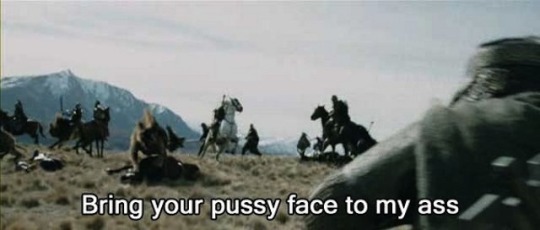
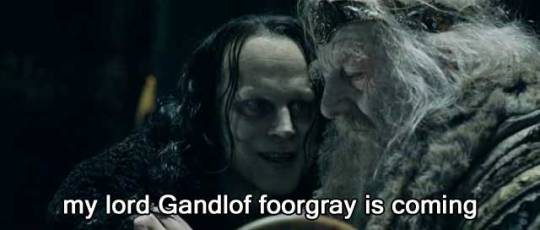
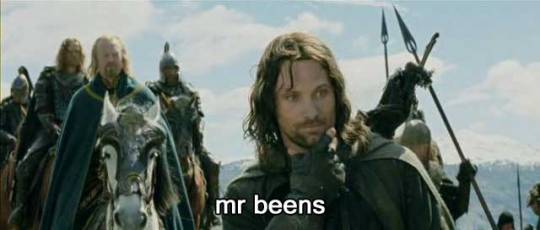
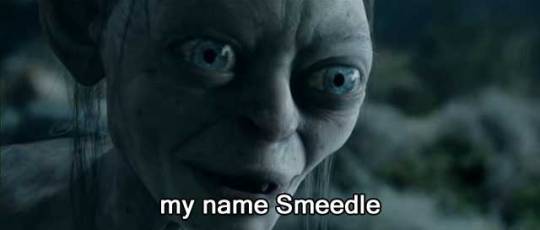
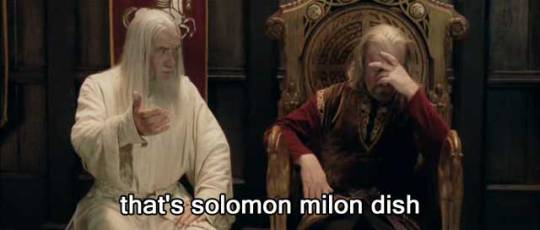
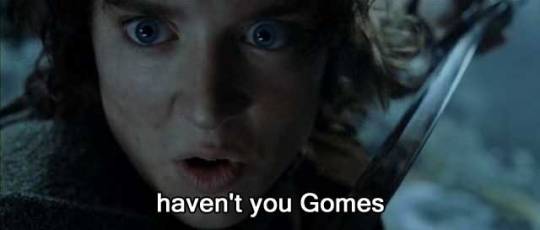
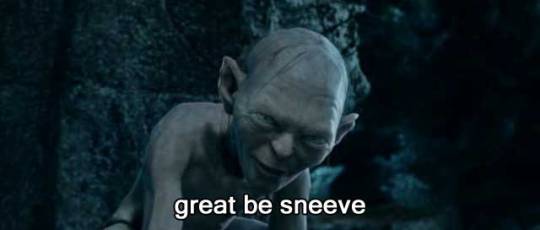
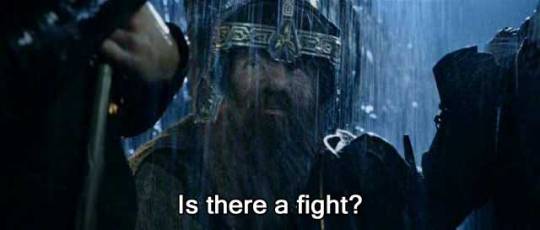
I pretend to be complex and clever but in reality, nothing has ever made me laugh harder than those bad Chinese subtitles from the bootleg Lord of the Rings DVDs. Tears streaming down my face, core aching, slowly suffocating because I’m laughing too hard.
also (because one can never have too many of these)
and my personal favorite:
I somehow forgot to add my own favorite, which is this one:
I also appreciate the ones that really change the tone and suggest that the characters openly loathe each other…
and this one, which gently encourages self-care:
listen you guys forgot some important ones
I AM DYING
I can’t stop laughing at “my name Smeedle”
I read this out loud and my sister nearly cried laughing
The Reunited Kingdom (also known as the Great kingdom) was the realm founded byHigh-King Elessar in the fourth Age.The Reunited Kingdom comprised the ancient terretories of Gondor and Arnor, with their former provinces Angmar, Enedhwaith, Harondor, Near-Harad, Umbar and Dorwinion as well as Mordor and Nûrn and tributary realms in Southern Rhovanion, Haradwaith, Far-Harad, and Rhûn as far as the Far fields of the East and Menelothriand.
Heraldry inspirted in Lindëfirion’s designs. Non-Canon alert
Writing and reading fanfic is a masterclass in characterisation.
Consider: in order to successfully write two different “versions” of the same character – let alone ten, or fifty, or a hundred – you have to make an informed judgement about their core personality traits, distinguishing between the results of nature and nurture, and decide how best to replicate those conditions in a new narrative context. The character you produce has to be recognisably congruent with the canonical version, yet distinct enough to fit within a different – perhaps wildly so – story. And you physically can’t accomplish this if the character in question is poorly understood, or viewed as a stereotype, or one-dimensional. Yes, you can still produce the fic, but chances are, if your interest in or knowledge of the character(s) is that shallow, you’re not going to bother in the first place.
Because ficwriters care about nuance, and they especially care about continuity – not just literal continuity, in the sense of corroborating established facts, but the far more important (and yet more frequently neglected) emotional continuity. Too often in film and TV canons in particular, emotional continuity is mistakenly viewed as a synonym for static characterisation, and therefore held anathema: if the character(s) don’t change, then where’s the story? But emotional continuity isn’t anti-change; it’s pro-context. It means showing how the character gets from Point A to Point B as an actual journey, not just dumping them in a new location and yelling Because Reasons! while moving on to the next development. Emotional continuity requires a close reading, not just of the letter of the canon, but its spirit – the beats between the dialogue; the implications never overtly stated, but which must logically occur off-screen. As such, emotional continuity is often the first casualty of canonical forward momentum: when each new TV season demands the creation of a new challenge for the protagonists, regardless of where and how we left them last, then dealing with the consequences of what’s already happened is automatically put on the backburner.
Fanfic does not do this.
Fanfic embraces the gaps in the narrative, the gracenotes in characterisation that the original story glosses, forgets or simply doesn’t find time for. That’s not all it does, of course, but in the context of learning how to write characters, it’s vital, because it teaches ficwriters – and fic readers – the difference between rich and cardboard characters. A rich character is one whose original incarnation is detailed enough that, in order to put them in fanfic, the writer has to consider which elements of their personality are integral to their existence, which clash irreparably with the new setting, and which can be modified to fit, to say nothing of how this adapted version works with other similarly adapted characters. A cardboard character, by contrast, boasts so few original or distinct attributes that the ficwriter has to invent them almost out of whole cloth. Note, please, that attributes are not necessarily synonymous with details in this context: we might know a character’s favourite song and their number of siblings, but if this information gives us no actual insight into them as a person, then it’s only window-dressing. By the same token, we might know very few concrete facts about a character, but still have an incredibly well-developed sense of their personhood on the basis of their actions.
The fact that ficwriters en masse – or even the same ficwriter in different AUs – can produce multiple contradictory yet still fundamentally believable incarnations of the same person is a testament to their understanding of characterisation, emotional continuity and narrative.
So I was reading this rumination on fanfic and I was thinking about something @involuntaryorange once talked to me about, about fanfic being its own genre, and something about this way of thinking really rocked my world? Because for a long time I have thought like a lawyer, and I have defined fanfiction as “fiction using characters that originated elsewhere,” or something like that. And now I feel like…fanfiction has nothing to do with using other people’s characters, it’s just a character-driven *genre* that is so character-driven that it can be more effective to use other people’s characters because then we can really get the impact of the storyteller’s message but I feel like it could also be not using other people’s characters, just a more character-driven story. Like, I feel like my original stuff–the novellas I have up on AO3, the draft I just finished–are probably really fanfiction, even though they’re original, because they’re hitting fanfic beats. And my frustration with getting original stuff published has been, all along, that I’m calling it a genre it really isn’t.
And this is why many people who discover fic stop reading other stuff. Once you find the genre you prefer, you tend to read a lot in that genre. Some people love mysteries, some people love high-fantasy. Saying you love “fic” really means you love this character-driven genre.
So when I hear people be dismissive of fic I used to think, Are they just not reading the good fic? Maybe I need to put the good fic in front of them? But I think it turns out that fanfiction is a genre that is so entirely character-focused that it actually feels weird and different, because most of our fiction is not that character-focused.
It turns out, when I think about it, I am simply a character-based consumer of pop culture. I will read and watch almost anything but the stuff that’s going to stick with me is because I fall for a particular character. This is why once a show falters and disagrees with my view of the character, I can’t just, like, push past it, because the show *was* the character for me.
Right now my big thing is the Juno Steel stories, and I know that they’re doing all this genre stuff and they have mysteries and there’s sci-fi and meanwhile I’m just like, “Okay, whatever, I don’t care about that, JUNO STEEL IS THE BEST AND I WANT TO JUST ROLL AROUND IN HIS SARCASTIC, HILARIOUS, EMOTIONALLY PINING HEAD.” That is the fanfiction-genre fan in me coming out. Someone looking for sci-fi might not care about that, but I’m the type of consumer (and I think most fic-people are) who will spend a week focusing on what one throwaway line might reveal about a character’s state of mind. That’s why so many fics *focus* on those one throwaway lines. That’s what we’re thinking about.
And this is what makes coffee shop AUs so amazing. Like, you take some characters and you stick them in a coffee shop. That’s it. And yet I love every single one of them. Because the focus is entirely on the characters. There is no plot. The plot is they get coffee every day and fall in love. That’s the entire plot. And that’s the perfect fanfic plot. Fanfic plots are almost always like that. Almost always references to other things that clue you in to where the story is going. Think of “friends to lovers” or “enemies to lovers” or “fake relationship,” and you’re like, “Yes. I love those. Give me those,” and you know it’s going to be the same plot, but that’s okay, you’re not reading for the plot. It’s like that Tumblr post that goes around that’s like, “Me starting a fake relationship fic: Ooooh, do you think they’ll fall in love for real????” But you’re not reading for the suspense. Fic frees you up from having to spend effort thinking about the plot. Fic gives your brain space to focus entirely on the characters. And, especially in an age of plot-twist-heavy pop culture, that almost feels like a luxury. “Come in. Spend a little time in this character’s head. SPEND HOURS OF YOUR LIFE READING SO MANY STORIES ABOUT THIS CHARACTER’S HEAD. Until you know them like a friend. Until you know them so well that you miss them when you’re not hanging out with them.”
When that is your story, when the characters become like your friends, it makes sense that you’re freed from plot. It’s like how many people don’t really have a “plot” to hanging out with their friends. There’s this huge obsession with plot, but lives don’t have plots. Lives just happen. We try to shape them into plots later, but that’s just this organizational fiction we’re imposing. Plot doesn’t have to be the raison d’etre of all story-telling, and fic reminds us of that.
Idk, this was a lot of random rambling but I’ve been thinking about it a lot lately.
“fanfiction has nothing to do with using other people’s characters, it’s just a character-driven *genre* that is so character-driven that it can be more effective to use other people’s characters”
yes!!!! I feel like I knew this on some level but I’ve never explicitly thought about it that way. this feels right, yep. Mainstream fiction often seems very dry to me and I think this is why – it tends to skip right over stuff that would be a huge plot arc in a fanfic, if not an entire fanfic in itself. And I’m like, “hey, wait, go back to that. Why are you skipping that? Where’s the story?” But now I think maybe people who don’t like fanfiction are going like, “why is there an entire fanfic about something that could have happened offscreen? Is anything interesting ever going to happen here? Where’s the story?”
Yes! Exactly! This!!!
This crystallized for me when I taught my first class of fanfiction to non-fic-readers and they just kept being like, “But nothing happens. What’s the plot?” and I was so confused, like, “What are you talking about? They fall in love. That’s the plot.” But we were, I think, talking past each other. They kept waiting for some big moment to happen, but for me the point was that the little moments were the big moments.
This explains so much about myself to me! 😭 I’ve been a big reader all of my life. I knew at a young age I wanted to get an English degree and become an editor. But then I found fanfiction, a little over ten years ago, and suddenly most regular fiction was too dry for me? I ended up dropping my English schooling after a year because there weren’t the same connections happening for me as there were in fic.
I’m suuuper character driven. I’ll read the same character in a hundred different ships, in all of the different fic genres and tropes, aus or what have you, because I like to see how they adapt to those changes. Those “offscreen” moments are just as important, if not MORE important, to me.
This speaks to me so much!
I’m in grad school rn and have been thinking about the fact that I DEVOUR fic but cannot get into “traditional” fiction unless I’m on break and *sit down* to read a book. Yet I was able to pick up a new Sarah Waters book and read it in two days (during term time!) because I was so invested.
After reading this interesting post(s) I realized I like her writing so much because she is like fic! I’ve long recognized that she is one of the few published authors that write with character driven stories aka why I like her (and Emma Donoghue’s) writing.
It’s also interesting that they are both women and also include lesbian relationships within their writing.
The reason it’s so good tho (and how I try to sell her books to my friends) is that the gayness isn’t a THING it’s just incidental to being human female people. And that’s how fic bills it too –just being people and that’s why we read it and fall in love.
Lots of thoughts on this –thanks for the post @earlgreytea68!
You’re very welcome! Honestly, I wrote this because I was trying to think through things in my own brain, but I feel like it also helped *me* make this huge breakthrough! I’d been having this very unsettled relationship with original writing and my difficulty getting back into it and I realized it was because I was treating it like a completely different genre. It really made me aware of what switches I’m pulling in my writing brain to make me move back and forth and no wonder I’m so creatively exhausted!
Anyway, I’ve really enjoyed reading everyone’s reactions to this post, they’ve been really interesting to hear about everyone else’s experiences and relationships to fic vs. “original” stories. I FEEL LIKE I FINALLY UNDERSTAND AFTER ALL THIS TIME WHAT @knackorcraft WAS TRYING TO TEACH ME, SORRY I’M SO SLOW!!
-You always have ideas. When you open a document, they disappear.
-You have a file full of ideas. It is lost. You open all your files and find hints of ideas mixed in between the lines. None of them connect. You follow them forever, deeper into the folders, until you can’t remember what you were looking for anymore. You end up reading fanfic until 4 AM.
-You’re not a torturer by profession. It’s merely a hobby. The sadism is a natural skill.
-Your fingers and wrists hurt from typing when you’re on a roll. You swear you’re not a masochist, but it hurts so good.
-Readers accuse you of causing them pain. You say you’re sorry, but you’re not. You comfort them while not-so-subtly digging for what caused them the most harm, eager to repeat the trick.
-Your friends enable you and laugh at your yelling. When you blame them, they claim they didn’t do anything. They never do anything. You no longer remember who started it, only that you’re halfway through the fic and still writing.
-You have a WIP. You swear you’re going to finish it next. It’s always next. There’s always another fic that has to be written first.
-Anonymous messages are sent to you, asking you not to acknowledge them publically. You know if you answer they’ll disappear from your inbox. Tumblr has eaten the Ask. Was it ever there in the first place?
-Someone comments on your fic. You have no idea who they are, but their username looks familiar. Every username looks familiar. You think you know them. They know you. It’s flattering, but you can’t shake the feeling that you should be alarmed by your poor memory.
-You reblog a writing prompt meme. It’s the same meme you reblogged yesterday. There are symbols instead of numbers, and you hope people will find them more interesting and send you more prompts this time.
-Promoting your own work is okay. You tell yourself this as you reblog yesterday’s fic post, tensely waiting for a rebuke that never comes.
-People laugh at something you wrote. You can’t figure out what. When you ask, nobody responds. They never laughed in the first place. You’re not sure you wrote anything.
-The fic is 50 hours long and 7000 words long; no one cares. A 10 minute speedwrite is reblogged into eternity.
-The kudos stack up. They are a solid block of names. You can’t read who left them. When you blink and look again, only 10 Guests have left kudos.
-Your inbox is full. There’s a comment on your fic. It has been edited 17 times. Six more emails come in as you read the initial comment. The numbers in your inbox climb and climb. You can’t find what’s been changed in the comment, but you can’t stop obsessively comparing each message.
-This comment is a book report. Glee and fear fill you in equal amounts.
-Someone apologizes for leaving a comment on an old fic. You can’t find who started the absurd rumor that authors don’t like comments on old fics. You plan their murder anyway.
-You eye your old username and associated fics. You pray that no one ever finds them. You resist the urge to tell people where to look.
-The fic is finished. You are dead. You are sick of it. You’ve never been so tired in your life. You hate the world. You force yourself to post it, absolutely exhausted, and suddenly can’t sleep for refreshing your inbox.
-The words multiply. You can’t control them. They eat your brain and come out your eyes. When people try to talk to you, you speak in snatches of character dialogue and narrate unconnected events. They keep talking to you, encouraging you to say more. The words own you now.
-No one believes you when you say the story is writing itself. You stare in despair at the screen. Why won’t anyone help you?
-You’ve misspelled ‘the.’ Autocorrect is wonderful until it’s not.
-Sleep is for the weak. You dream you’re still writing.
-The fic is 50 hours long and 7000 words long; no one cares. A 10 minute speedwrite is reblogged into eternity.
Hahaha, ah it’s funny because it’s true. *eyetic* what do you mean there’s blood coming out of my nose? No, no I’m fine, go right ahead. Reblog the scone post again, I don’t mind.
-Someone apologizes for leaving a comment on an old fic. You can’t find
who started the absurd rumor that authors don’t like comments on old
fics. You plan their murder anyway.
GODS OWN TRUTH. Who told readers that there’s a statute of limitations on commenting? Why is apologizing for commenting so common? Who has abused these readers for sincerely expressing their appreciation and affection for fanwork?